
66.1,2
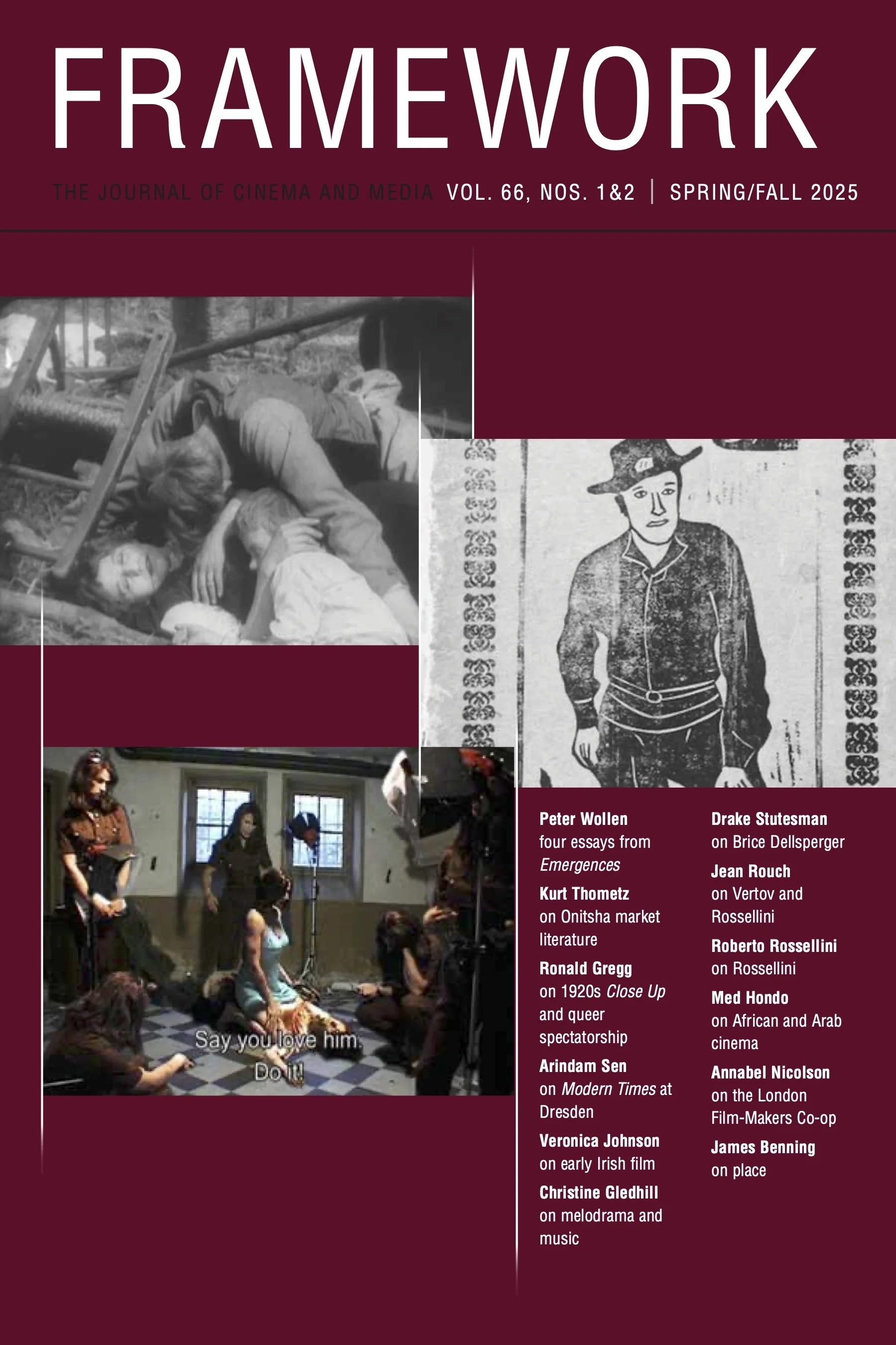
CONTENTS
Drake Stutesman
Editorial
DOSSIER: Peter Wollen: Four Essays, 1995-2002
Leslie Dick
Introduction to Peter Wollen Dossier
Peter Wollen
Cricket and Modernity
Peter Wollen
The ‘World City’ and the ‘Global Village’
Peter Wollen
The Archipelago of Metaphors
Peter Wollen
Kim: The More Things Change the More They Stay the Same
Kurt Thometz
No Condition Is Permanent: On Eastern Nigeria’s Incunabula
Ronald Gregg
Close Up, Late Silent Film, and Queer Spectatorship
Arindam Sen
Review of Modern Times. The American Dream and the Avant-Gardes of the 1920s at the Archiv der Avantgarden, Dresden
Veronica Johnson
Knocknagow, or the Homes of the Tipperary: Irish Sentiment for the Homeplace and Migrant Audiences
Christine Gledhill
Choreography of Musical Feelings: Melodramatization of the Cinematic
Drake Stutesman
Inhabitation of Space: Brice Dellsperger’s Reenactment Video Body Double X, Charivary, and Performance
DOSSIER: Filmmakers on Film: Five Directors Writing on Film: Archival Reprints from Framework, 1979-190
Jean Rouch
Five Faces of Vertov
Jean Rouch
On Rossellini
Roberto Rossellini
Summing Up
Med Hondo
What Is the Cinema for Us?
Annabel Nicolson
London Film-Makers Co-operative
James Benning
On Place
EDITORIAL
The double issue Framework 66 1&2 brings together writings that share a kin- dred theme of illuminating unusual subjects through unusually close readings. The issue’s opening dossier, Peter Wollen, Four Essays, 1995–2002, introduced by writer and art critic Leslie Dick, reprints four rarely seen essays by Peter Wollen—“Cricket and Modernity,” (1995–1996), “The ‘World City’ and the ‘Global Village,’” (1999), “The Archipelago of Metaphors,” (2000), and “Kim: The More Things Change, the More They Stay the Same,” (2002). These pieces have been published previously only once, in Emergences, a small magazine ini- tiated by UCLA graduate students, during the time Wollen was teaching there. Framework is fortunate to reprint them for the first time.
In “No Condition Is Permanent: On Eastern Nigeria’s Incunabula,” Kurt Thometz, book dealer and private librarian, reveals the Nigerian Onitsha Mar- ket Literature world of street chapbooks that dominated Nigeria as a popular phenomenon from the end of World War II to the 1960s and have been a part of the Nigerian expatriate world in New York. Thometz curated a 2025 exhibi- tion at Yale University with pamphlets from his personal collection. This essay is formed from a talk that he gave in a New York club in 2025 and specifically mirrors the talk’s informal style in a manner that brings to life the subject’s wide influence and his own collaborations.
Ron Gregg, in “Close Up, Late Silent Film, and Queer Spectatorship,” gives a fascinating look into 1920s beginnings of the groundbreaking magazine Close Up to show how queer writers were instrumental in its world perspective, rec- ognizing Close Up as “an early space for queer community, collaboration, and spectatorship, and the building of a transnational queer canon.”
Arindam Sen’s “Review of Modern Times. The American Dream and the Avant-Gardes of the 1920s at the Archiv der Avantgarden, Dresden” augments some of the ideas spurring the international 1920s art scene in his review of the Dresden exhibition, held in June 2025, that reassessed and resituated the rela- tionship between American and European avant-garde art at that time.
In “Knocknagow, or the Homes of the Tipperary: Irish Sentiment for the Homeplace and Migrant Audiences,” Veronica Johnson focuses on the Film Company of Ireland, founded in 1917, Ireland’s first indigenous fiction film company. Her detailed essay looks in particular at ways in which the company’s films’ coded representations of “home” were read by their audiences, especially abroad and also especially by the many young Irish women working in the United States in the notoriously difficult job of domestic service.
Christine Gledhill, in “Choreography of Musical Feelings: Melodramati- zation of the Cinematic,” reveals melodrama’s complex relationship involving music, spoken word, and action, showing a synergistic relationship with these elements that places music beyond an auxiliary art used to support a play’s dra- matic moments.
Drake Stutesman’s “Inhabitation of Space: Brice Dellsperger’s Reenact- ment Video Body Double X, Charivari, and Performance” looks at French video artist Brice Dellsperger’s reenactment video Body Double X (FR, 2000), based on Polish director Andrzej Żuławski’s 1975 film L’important c’est d’aimer/The Important Thing Is to Love and places its use of appropriation of material to remake it into an entirely different “act,” into hundreds of years of Western the- ater, and also places the video’s intransigent use of cross-dress into centuries of the use of cross-dress as a crucial tool in violent labor dissents.
The issue’s final dossier, “Filmmakers on Film: Five Directors Writing on Film—Archival Reprints from Framework 1979–1980,” reprints Framework articles written by film directors. Included are Jean Rouch’s “The Five Faces of Vertov” and “On Rossellini,” Roberto Rossellini’s “Summing Up,” Med Hondo’s “What Is Cinema for Us?,” Annabel Nicolson’s “London Film-Makers Co-operative,” and James Benning’s “On Place.”
—Drake Stutesman
